Conferences
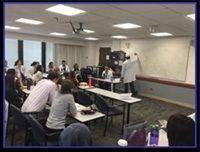
Educational sessions take place in-person. We provide a virtual option for residents on outside rotations and electives.
Educational conferences everyday from 12-1 p.m.
Our educational conference series features a robust set of longitudinal topics designed to support both clinical excellence and professional development. Core sessions include board review, case conferences, journal club, quality improvement, global health, advocacy, and resident wellness. The series also incorporates dedicated lectures on bioethics, research methodology, evidence-based medicine, and career development.
Case conferences are led by senior and chief residents providing a structured forum to discuss complex clinical cases, develop differential diagnoses, and highlight key clinical pearls. These sessions serve as an essential teaching opportunity for our residents to grow as educators while fostering collaborative learning across all training levels.
Educational sessions are presented by pediatric faculty, and topics are repeated twice over the three years of residency training. The goal for these sessions is to review pediatric board specific content with different modalities including presentations, team-based learning and board review questions.
Grand rounds: Wednesday from 12-1 p.m.
Pediatrics Grand Rounds provides cutting edge information on a wide variety of pediatric topics and is directed toward faculty, residents, community pediatricians, and hospital staff. In addition to our extensive pediatric subspecialty and surgical faculty, presenters include both local and national speakers. Once monthly multidisciplinary case conference is an interactive panel discussion amongst residents and faculty where a particularly challenging case of patient morbidity or mortality is reviewed. This lecture series is presented via Microsoft Teams.
Academic half days (AHDs)
All residents in the program are divided into learning cohorts of approximately 16-20 residents determined by their "Y" week in the X+Y schedule. Cohorts are composed of residents of all levels who learn together throughout the academic year in two small group academic half days.
Outpatient AHD
- Outpatient general pediatrics academic half day occurs once a month for each cohort of residents during their ambulatory clinic week. This small group session includes one resident cohort and an outpatient general academic pediatrics faculty member. These sessions review high-yield topics related to clinical practice to help ensure that all residents develop a solid outpatient pediatric knowledge base. During each session, residents have the opportunity for case-based learning, developing their teaching skills, and participating in team-based learning. The curriculum is designed to be repeated every 18 months in order to reinforce concepts over the course of residency.
Board review course
Each spring, we integrate a structured two-week long board review course at the end of the year for all our PGY3s to provide comprehensive preparation for the pediatric board exam. Using a classic board review “hot topic” format, faculty deliver high-yield, exam-focused content.
This dedicated board review week is protected time for all PGY-3 residents, allowing full immersion in a classroom-style learning environment without clinical responsibilities. During this period, rising PGY-3 residents (current PGY-2s) assume senior-level roles on the inpatient service. This model supports effective board preparation for graduating residents while providing valuable leadership and clinical experience for PGY-2 residents transitioning into the senior role.
Mock In-Training Exam (ITE)
Biannually we administer a Mock ITE that is prepared by chief residents using past PREP questions. Questions are graded and answer explanations provided to the residents. This is an important way that residents can trend progress of their board prep throughout their 3 years and supplements the annual In Training Exam from the American Board of Pediatrics.
Journal club/evidence-based medicine workshops
Journal Club is held throughout the academic year and features PGY-2 residents leading discussions of peer-reviewed journal articles of their choice. Sessions use a Critically Appraised Topic (CAT) format to evaluate the validity, methodology, and clinical applicability of the research. Each resident class works through a structured set of questions, which are then reviewed collectively to promote active discussion and shared learning.
The primary goal of Journal Club is to develop the skills necessary to become thoughtful and effective consumers of clinical research. In addition, multiple board-relevant biostatistics topics are integrated throughout the year. Faculty members, along with the Director of Pediatric Research, attend these sessions to guide discussion and provide expert feedback on the residents’ analyses.
Procedural skills workshops
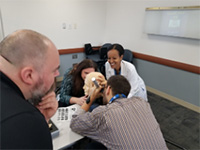
Interactive workshops on a variety of procedural skills are held throughout the year. These include peripheral IV's, intubations, central line placement, otology, suturing, catheterizations, lumbar punctures and splinting. Faculty demonstrate the techniques on models and residents are provided with the time to develop the manual dexterity and knowledge necessary to perform these procedures.
Residents are encouraged to practice procedures in real time prior to performing them on patients. Trainer devices are available for lumbar puncture, venipuncture, intubation, central line insertion, chest tube insertion, and bladder catheterization.
Simulation lab
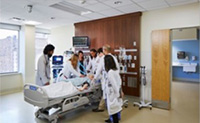
Residents practice their resuscitation skills in the state-of-the-art simulation center. Advocate Children’s Hospital in Park Ridge is proud to be the home of Advocate’s largest Simulation Center. Simulations are held quarterly, and residents and nursing staff are assigned to participate in these sessions supervised by our Chief Residents and the ACH Director of Simulation. Each resident participates in at least 3 group simulations a year, 1 NICU Simulation, a communication simulation, to practice difficulty conversations along with smaller-individualized sessions in the PGY1 year. These sessions are followed by a debriefing during which participants give and receive feedback on both the medical and teamwork components of resuscitation.